
If you’ve been hearing the word “peptides” more and more in professional hair care, there’s a good reason. Peptides are quickly becoming one of the most talked-about ingredients in the industry — and unlike many trends, the science behind them is real.
Let’s break down what peptides actually are, how they work on hair, and why they’re changing the way professionals approach damage repair.
Peptides 101: The Basics
Peptides are short chains of amino acids — the same building blocks that make up proteins like keratin, which is what your hair is primarily composed of.
Think of it this way: if keratin is a brick wall, peptides are the individual bricks. When hair is damaged by heat, chemical processing, or environmental exposure, the keratin structure breaks down. Peptides can help rebuild that structure from the inside out.
How Peptides Repair Damaged Hair
When bioactive peptides are applied to hair, they’re small enough to penetrate the hair shaft and interact with the damaged protein structure. Here’s what that means in practical terms:
- Bond strengthening — Peptides help reinforce the disulfide bonds that give hair its strength and elasticity. When these bonds break (from bleaching, heat styling, or chemical services), hair becomes weak and brittle. Peptides support the rebuilding of these critical connections.
- Free radical protection — Certain peptides carry antioxidant properties that neutralize free radicals — the unstable molecules caused by UV exposure, pollution, and heat that accelerate hair damage over time.
- Moisture retention — Damaged hair loses its ability to hold moisture. Peptides help restore the hair’s natural moisture barrier, resulting in softer, more hydrated strands.
- Elasticity restoration — Hair that’s lost its bounce and flexibility often has compromised protein structure. Peptides help restore that elasticity, which is especially important for curly and textured hair types.
Why Peptides Are Different from Traditional Repair Ingredients
Traditional repair products often rely on silicones to coat the hair’s surface, creating the appearance of smoothness without actually fixing the underlying damage. Peptides work differently — they target the internal structure of the hair fiber.
That’s not to say surface-level products don’t have their place. But if you want real, lasting repair (not just a temporary cosmetic fix), peptides are the ingredient to look for.
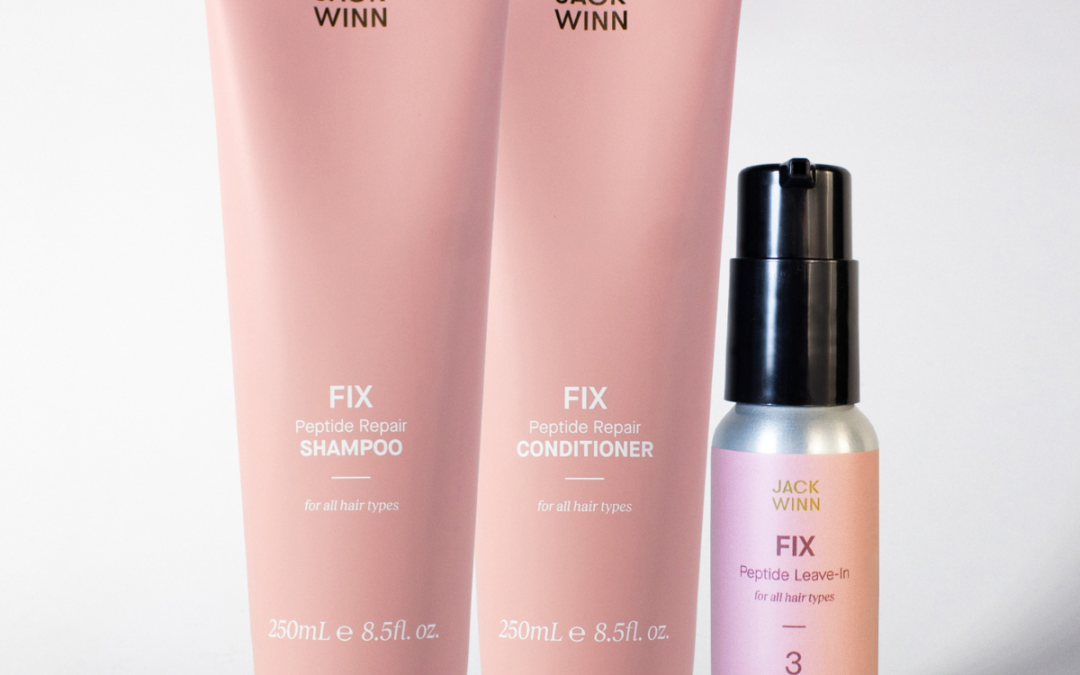
The Science Behind Fix by Jack Winn Pro
Our Fix Peptide Repair System was formulated by our founder, Jack Winn — who holds a degree in Chemistry — to address damage on three fronts: repairing broken bonds, neutralizing free radicals, and restoring moisture and elasticity.
Fix uses pharmaceutical-grade bioactive peptides combined with natural botanicals, all manufactured in Italy where centuries of beauty formulation tradition meet cutting-edge science.
The result? Hair that’s not just smoother on the surface — but genuinely stronger, more elastic, and more resilient from within.
The Bottom Line
Peptides represent a genuine shift in how we think about hair repair. They’re backed by real science, they deliver measurable results, and they’re especially valuable for clients who undergo frequent color or chemical services.
As a stylist, understanding peptide technology gives you a meaningful edge when educating your clients about why certain products work — and why their hair is worth the investment.
Want to see peptide repair in action? Explore the Fix collection and see the science for yourself.