
Who owns your hair color brand?
If you’ve never asked that question about the color you mix every day, it’s worth pausing on. Who owns your hair color brand determines almost everything else about it — the ingredients, the price, and the relationship you actually have with the company behind the bottle.
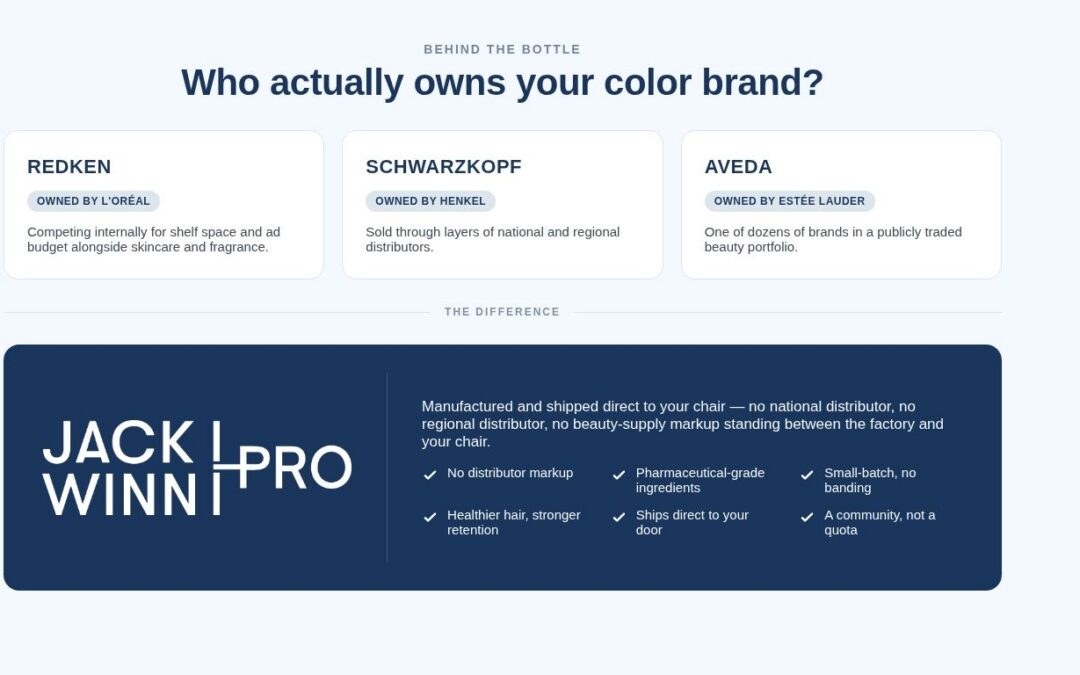
L’Oréal, the largest cosmetics company in the world, owns Redken. Henkel, a German multinational conglomerate, has owned Schwarzkopf since 1995. The Estée Lauder Companies — a publicly traded beauty conglomerate with dozens of brands in its portfolio — owns Aveda.
None of these are independent companies built around stylists. They’re product lines inside much larger corporations. Each one competes internally for marketing budget and shelf space, right alongside shampoo, skincare, and fragrance.
So why does who owns your hair color brand actually matter?
How does Jack Winn Pro’s supply chain differ from these conglomerate brands?
Products from brands like these typically move through four or five hands before they reach your chair. The parent company manufactures it (or has it manufactured). A national distributor buys it. A regional distributor buys it next. Then your local beauty supply store buys it. Only then does it reach you.
Every one of those steps adds margin. Industry insiders have long estimated that the raw formula itself costs pennies on the dollar of what you pay at the counter — often somewhere in the 30-40 cent range. The rest goes to packaging, national ad campaigns, celebrity endorsements, and the layers of distributors standing between the factory and your chair.
Jack Winn Pro cuts that chain out entirely. We manufacture and ship directly to licensed professionals. No national distributor. No regional distributor. No beauty supply markup. That means the money that would have gone to the fourth or fifth hand in line goes into the formula instead — pharmaceutical-grade ingredients at professional pricing.
Why does ingredient quality and manufacturing consistency actually matter for color results?
This is where the “pharmaceutical-grade” claim stops being a marketing phrase and starts showing up behind the chair.
Higher-quality ingredients stay more stable and more consistent, batch after batch. Jack Winn Pro manufactures in small batches specifically so we can control quality from one production run to the next. That means a level 6 you mix today and a level 6 you mix six months from now come out the same — the same perfect light brown, not a shade warmer or cooler because a different manufacturing run used a slightly different concentration of raw material.
That consistency is what prevents banding and dark lines on touch-ups. When a color line’s formulation drifts even slightly between batches, a stylist doing a routine root touch-up months later can end up with a visible line of demarcation. It’s not because they did anything wrong — the product itself changed underneath them. Small-batch manufacturing with tight quality control keeps that from happening.
The same holds true for hair health over time. When a color line is genuinely gentler on the hair — not just on the day of service, but cumulatively, appointment after appointment — clients notice it in ways that go beyond the color itself. It shows up as clients coming back three or four months later and saying their hair simply feels thicker and healthier than it used to.
None of this is cosmetic. It’s the difference between a client who tolerates their color service and a client who comes back and refers their friends. Taking care of the professional’s results this precisely is what drives client retention. And client retention is what actually grows a stylist’s business.
Why is Jack Winn Pro’s pricing different from conglomerate-owned brands?
Because the business model is different, not just the price tag. A brand inside L’Oréal, Henkel, or Estée Lauder has to fund a supply chain and a marketing machine built for a much bigger portfolio: glossy packaging, national ad campaigns, a rotating cast of influencers, a sales rep whose job is to keep showing up at your door. All of that costs money, and that money comes from somewhere — your price per tube.
We don’t have a sales rep calling you every week. We don’t have a glitzy ad budget. What we have instead is a direct portal. You log in, you order, and it ships to you at the price that reflects what’s actually in it.
Do I have to drive to a beauty supply store to buy Jack Winn Pro?
No. This is one of the most overlooked costs in the industry: the gas, the time, and the “while I’m here” impulse buys that come with a beauty supply run. Jack Winn Pro ships directly to you. No drive, no distributor shelf, no upsell on your way to the register.
What kind of community comes with Jack Winn Pro, compared to a conglomerate brand?
Redken, Schwarzkopf, and Aveda are each one line inside a company with dozens of other priorities. Your relationship with them runs through a distributor and a sales rep — it’s transactional by design.
Jack Winn Pro is built around a community of independent stylists who educate each other, refer each other, and get rewarded for lifting each other up. It’s a direct relationship with the brand and with the people using it beside you, not a rep hitting a quota.
What does Jack Winn Pro not spend money on?
To be direct about the tradeoffs:
- No glitzy, oversized marketing budget
- No pile of branded swag
- No sales rep checking in on you weekly
- No beauty supply distribution markup
- No layers of national and regional distributors between the factory and your chair
What replaces all of that is a portal you log into, a direct relationship with the brand, and a formula built with the money that would have gone to everyone standing in line ahead of you.
The bottom line
Big conglomerate color brands are optimized to hold your attention. New packaging, new influencer, new campaign, every season — because they’re competing for budget inside companies that also sell fragrance, skincare, and mass-market shampoo.
Jack Winn Pro is optimized for what’s actually going into the bottle and getting to your chair at a price that reflects that. Once you know who owns your hair color brand, the difference in what shows up in your results — consistent shades, no banding, and clients who come back healthier and stay longer — stops looking like an accident. It’s the business model.